Showing posts with label Melancholy. Show all posts

28 Dec 2014

Melancholy of the American Baroque


Man and woman with stern expession stand side-by-side. The man holds a pitch fork.
I can see that my posts on Melancholia enjoy enduring popularity among my visitors. Here is a bit more....

May of us know the painting by Grant Wood, American Gothic.
Should't it be called American Baroque? --->
The thesis is that really, as in Poland, in the United States of America Baroque continued well into the 19th century.


Just a small selection of 19th century daguerreotypes from the fascinating collection of Library of Congress reveals so much melancholy in the images of people;


Still Life with tree and two small stuffed mammals
Including the images of detritus and decay so well arranged Vanitas in the early nature shots.

24 Feb 2013

Ervin Panofsky - Melancholy again...

German Art historian, fled the Nazi Drang and Sturm and taught in the US.
Proponent or even founder of Iconology (study of meaning, content).
"...together with A. Warburg and F. Saxl provided the foundation for the iconological approach to the study of works of art. Striving to overcome the one-sidedness of both the stylistic and the purely iconographic approaches, he proposed that a work of art be considered as a characteristic manifestation—a sign or “symptom”—of a cultural-historical situation, which is reflected not only in the choice of the subject but also in the artistic style. In his research, which was devoted mainly to medieval and Renaissance art, Panofsky analyzed peculiarities of form within the context of a philological and historical-philosophical interpretation of the content." Russian Encyclopedia
Anyway, Panofsky, being a German had enormous interest and knowledge of German art and of Albrecht Durer in particular. Together with several authors, a work has taken shape of a true compendium of the knowledge of and and history and anthropology, literature, medeval medicine you name it - around the theme of Melancholy. A. Durer's "Melancholy I" was the trigger of the work (by the way, apparently there was Melancholy II, but is no more...)

File:Dürer Melancholia I.jpg
Melancholia I, A.Durer (Wiki)
Being so interested in certain subjects of Art History I sought this book for quite some time.
Last year I became desperate, I looked on Amazone and almost dropped dead: over 700.00 for a used copy,  this book has been out of print in English since its only print run in 1964!
Christ, I thought, I need to rob a bank. But, I looked more and there I found it:  a complete Polish translation, hard cover with dust jacked so what did I do - I have asked my darling sister, to buy me this book. Apparently this book has been printed also in German and in Spanish relatively recently - obviously the countries where the interest in certain themes and motives of history of art never die.

My sweet Lila bought me this book - Raymond Klibansky, Erwin Panofsky and Fritz Saxl.
I can marvel to my heart's content in the matters that interest me so much. Last year, "out of nostalgia for melancholy" I have reproduced myself a small self-portrait of Durer, as a young man, this one -->

This book is amazing in the amount of detail, you can imagine over 400 pages, two-colums text is a lot of good read... It is a collection of study of those three men, poor Mr. Saxl never lived to see the first printed edition.


Here is a book, right on my lap, as it arrived on Februrary 12, 2013!
It has prompted me to post several of earlier drafted posts on one of my favourite subject - the Big M

Thank you Sis!

22 Feb 2013

Nostalgia vs Melancholy, Funerary Art

Will we enter the new era of Nostalgia? Or, perhaps another period of it, or maybe we have never been without it? Are we amidst such period?

In 2008 Vienna Museum featured hugely successful showcase of Vanitas in art. What would I give for the catalogue of it....

Favourite symbols beaming from the canvases
asking the question of Essential Melancholy:
In ictu oculi ("In the blink of an eye") a vanitas by Juan de Valdés Leal

Ubi sunt? 

¿Qué se fizo el rey don Juan?

Los infantes de Aragón
¿qué se fizieron?

¿Qué fue de tanto galán,

qué fue de tanta invención
como trujeron?


What became of King Don Juan?
The Princes of Aragon,
What became of all of them?
What of so much handsome nobility?


This canción relies on the motives of things of this world that are gone by, hence letting us that we may be next in line....

That's just what this is - Where are the flowers gone, from 1961.


1 Jan 2013

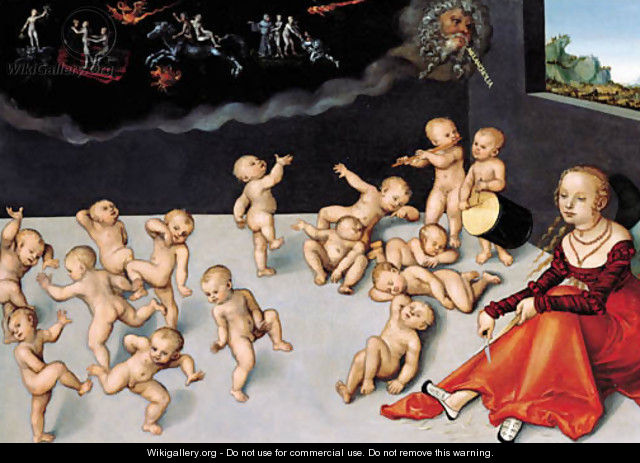
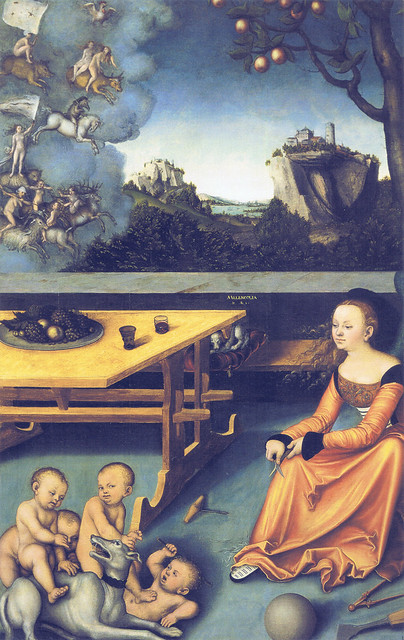
Cranach - Four takes at Melancholy

Further to my favourite study of Big M:
Here is the little lightbox of images of Melancholia.
Apparently Lucas Cranach, the Elder created four versions of Melancholy - shown below from various sources.
Two images are the bottom are coming from the Flickr site, uploaded by pertrus.agricola.
He includes an amazing close-up of one of the paintings.

At a first glance I have no idea what the paintings are all about and what's it got to do with Melancholy. For my money, having so many naked babies around me playing with spheres and arrows, dogs and partridge running loose around the kitchen - I don't know anyone who wouldn't get melancholic in the face of that disaster.
I know, I am getting a little..... overwhelmed.

The works are obviously veiled and rather crypted.
I am yet to learn terribly a lot, armed with a copy of the Klibert, Panofsky, Saxl, book  Melancholy I.
This book became my little Christmas wish, I found it online and it is on its way...

At the moment, it seems that the eyes of the lady, especially in the versions from 1528 and 1532 may be those of Katherina von Bora, the wife of Martin Luther.
They new each other and Cranach was a close friend of the family, something I had read pointed to those eyes of the model.
There was something I had read about the this painting --->

Madonna under the fir tree (1510), Archdiocesan Museum, Wrocław. One of the most distinguished and elaborated of the Cranach's Madonnas.


Or maybe poor old Luc Cranach who knew Katherina from before she got married to Luther (I think so) and once he saw her with her babies thought holly crap, poor Kate...
something like this. I don't know. Maybe she was getting, like --- depressed....

I cannot see the eyes in the first two pics - they are too blurry so the search continues....

Melancholia - Lucas The Elder Cranach


There is a really interesting post and related comment on newly found blog:
http://ferrebeekeeper.wordpress.com/2010/09/16/melancholy-by-lucas-cranach/
I just read a bit of this blog and it is absolutely fabulous read for those husky golden retrievers as I...

It is the source of this pic --->
Lucas Cranach, the Elder
Melancholy
(1532) Oil on panel. 51 x 97 cm.
Copenhaguen, Statens Museum for Kunst)


photo


Lucas Cranach the Elder
The Melancholy
[1528]
One of four version, that Cranach painted with that topic.
Private Collection, on loan to the National Gallery of Scotland, Edinburg
photo


Lucas Cranach the Elder 
The Melancholy, detail [1532]
One of four version, that Cranach painted with that topic.
Colmar Musée d'Unterlinden


photo 


A fortified castle "on the rocks"
Lucas Cranach the Elder 
The Melancholy, detail [1532]
Copenhagen National Art Museum (Statens Museum)

13 Nov 2012

W. Herzog - Death in Five Voices

If you are a Werner Herzog fan I would love to meet you.
If you are not, but would like to be, I would love to meet you.
If you live in the nearest - I don't know - 3,000 km from Ottawa and would like to travel and join me in a "fan club" just to share worship and all kinds of thoughts, let me know. 

I have blabbed somewhere earlier about Herzog being a quintessentially baroque artist.
Here, in the "Gesualdo - Death for Vive Voices", he expresses his interests so much more literally.
His generosity is so immense as he narrates with his great voice in a well poised,and pensive manner. He takes us on voyages to the regions of our human experience and memory where in deep peace resides mistery, side by side with a certain danger of....

We are prone to laziness and self-cherishing and he volunteers to take us on those "field trips" to the obscure rooms of the 19th century Natural History collections of oddities, to exploring those areas of danger and uncertainty.
Gesualdo is not a mere "Memento Mori", it is melancholia as the "divine madness", here in Gesualdo's case - perhaps a lot more and how it becomes a legend...

About "black bile", the melancholia I will write more and more. One of my favourite subjects.
By the way, have you watched "Gesualdo"?  If not, you may take a look:


17 Dec 2011

Cesária Évora has died

Thanks to good old Ces for giving us so much.
Thanks to all good people you saw her talent and, in spite obstructions, helped her to broadcast her talent. 

I've hear her sing at the Ottawa International Jazz Festival few years back and I was surprised wih how unassuming she is, almost disinterested in the crown she is facing, just immersed withing the song. Her dress was so unfashionable, and her voice beautiful.
It all sounded of difficult life and long gone dreams...
It was not all happy singing, there was "sawda" in it. There was "black bile".
It wasn't just Nostalgia - it was Melancholy. 
"A somewhat melancholic feeling of incompleteness" used to describe saudade would probably be it.

She has also proven to women across the world that youth and glam is not the necessary prerequisite and good things continue after you start shaving....


Sleep well love...
Related Posts Plugin for WordPress, Blogger...