Showing posts with label Lucas Cranach the Elder. Show all posts

19 Dec 2013

Lucas Cranach the Elder, still leading...

The most frequently read post of this blog is the one on Melancholy and the paintings of Lucas Cranach. I admire his painting and that of his influence. 

http://www.art-in-duesseldorf.de/upload/Slideshow-Sets/Cranach-Archiv/cranach_01.jpg
Lucas Cranach the Elder, Portrait Study of a Young Man, c.1530. Paper, 26.2 x 19.9 cm.
Los Angeles, J. Paul Getty Museum. Detail. (Foto: Heydenreich, cda)

Lucas Cranach the Elder, The Apostle Peter, c.1515. Panel, 26.5 x 17.5 cm.


I couldn't resist and would like to dedicate those two close-ups from his paintings to my fellow Cranach fans.
Lucas has clearly made a transition from Medieval to Renaissance.

The eye of the Apostle Peter s how so much more three-dimensionality and the crafted reflections of the room in a shape of the cross bring so much more narrative to the painting.
Those are a part of a Cranach have been found on a wonderful site http://www.art-in-duesseldorf.de/

One envies the rich European culture scene....


18 Aug 2013

The Autumn of the Middle Ages

One of the greatest, albeit somewhat bitter joys of the recent times is inheriting part of a book collection that once belonged to our friend and the most formidable intellectual companion - Antony and his wife Anna.

I have been reading first is "The Waning of the Middle Ages", for almost a century a staple read for those interested in the history of medieval Burgundy.

Amazing, vigorous accounts of times in the once vast and powerful reign spanning almost from the South of France to the Netherlands. A rich, often ruthless, eccentric, unjust, opulent yet extremely interesting and vigorous culture that radiated its influence with development in social forms, in art and literature.

The book has been in print, in various editions repeatedly. It has received some criticisms, but - who cares about critics, it still stands as a great read.


It is an older, Polish edition as Antony was a predominantly Polish reader. The illustration on the cover show a sample of courtly portraiture that flourished at that time.


Portrait of a Young Girl, ca 1470
It has been painted by Petrus Christus, a student of Jan van Eyck. 

The genre of young girls portraits became well established in those times as portraits of young "well-born" ladies was an indispensable tool of the matchmaking, the political power arrangement.

The looks mattered, the manner of the sitting was usual formal, the clothes, the jewels and head pieces are now such invaluable window into the way of life at the courts of Europe.

Young ladies at the onset of puberty, often around the age of nine were considered suitable for the marriage negotiations.


In the past, I used to reproduce some of those most beautiful early portraits of young women.

They were usually small, 10 -12 inches max canvases, gloss-varnished and framed in the most antique looking frames I could find.

I think I have neglected my favourite pastime a bit - I should catch up.


Margot Valois by Jean Clouet, 1560

This painting is no longer medieval, but show the continuation of the popular tradition.

It is of the portraits from much later period which I reproduced, enhancing the image file of course considerably, was this one. Beautiful painting that led bringing closer Valois with the rest of the Burbons, and to her becoming the wife of the King of France and Navarre, as the wife of Henry IV.


Remember the movie "Queen Margot" with Isabelle Adjani?


Elisabeth of Austria, ca 1571


Jean Clouet was an accomplished and well sought portrait painter.


Tradition, again, was continued by Jean's son, François Clouet.

Another young and impressively clothed and adorned young lady, later queen of France, wife of Charles IX. ->


Catherine of Aragon
For the record: one of the most stunningly beautiful portraits I had reproduced is this one, attributed in Michel Sittow. This painter was born in what is now known as Riga, Estonia and was also trained in the Early Neaderlandish tradition.

He made his fame and impressive honoraria at the court of the Isabella of Castile* who recommended his skills to Elisabeth, the French Queen. Both ladies were of the Habsburg house, first by marriage, the second by birth.


This exquisite portrait is that of Catherine of Aragon. Staunchly Catholic, the rim of her head-piece and piously lowered gaze suggests the aura of sainthood. She was the daughter of Isabella of Castille and later, the famous first wife of the "infamous" Henry the VIII.


Michel Sittow was trained under Hans Memling likely in Bruges.

Last Judgement, triptych, Hans Memling


Memling continued in the style of Rogier van der Weyden, the Early Flemish painter who, is said, in his days eclipsed van Eyck.

Memling did not specialize in portraiture, but specifically in large religious compositions, with "The Last Judgement" triptych being one of his most magnificent paintings.

Rogier van der Weyden worked in Dutch-speaking Brussels at the court of Philip the Good, a great patron of the arts - the Duke of Burgundy and Count of Artois.

And that's were much of "The Waning of the Middle Ages" takes place...

Oh, to be in Bruges!


Isabella of Portugal by Titian.jpg
Titian, Isabella of Portugal, 1548
I couldn't resist few more portraits, no longer representing Early Neatherlandish (Flemish Primitive) style:

No longer Medieval in style, but clearly renaissance by Titian - portrait of Isabella I of Portugal. This woman was a granddaughter of the powerful Spanish queen Isabella of Aragon*. It has been said that she was a woman of uncanny beauty.She died young leaving many unconsoled.


And last (for now) the portrait of Anne of Cleves, another wife of Henry the VIII.
She was not the most beautiful of the wives, but certainly she has been the subject of one of the most beautiful portraits of all times.


File:AnneCleves.jpg
Hans Holbein the Y, Anne of Cleves, ca 1539


Painted by Hans Holbein the Younger, she must have captivated him by a particular demeanor and definitely by this amazing outfit.
http://upload.wikimedia.org/wikipedia/commons/7/74/Lucas_Cranach_d._%C3%84._040.jpg
Lucas Cranach the Elder,
Sybille of Cleves
, 1526
Regardless of the ornate dress, the same artists made a portrait of yet another wife - Jane Seymour,, making poor Jane looking like a peasant girl in comparison with this absently looking German princess...

Holbein was a Protestant and his style clearly represents the interests of Renaissance. He made considerable career in England after being recommended by the fellow Reformer, Erasmus of Rotterdam to Thomas Moore.


This portrait is of Anne's sister - Sybille of Cleves.
Painted by Lucas Cranach the Elder. Different painter, different dress...

http://upload.wikimedia.org/wikipedia/commons/7/7f/Lucas_Cranach_the_Elder_-_Judith_with_the_Head_of_Holofernes_-_Google_Art_Project.jpg
Judith with the Head of Holofernes
ca 1530
Lucas Cranach the Elder was about 30 years older than Hans Holbein the Younger. Their styles are much different. Cranach is a distinctly a Gothic painter.
The is another portrait of a young woman that needs to me mentioned:

I have written about L.Cranach E. more here.


It's a beautiful painting.

I know, this head... Hmmmmm. I don't know...
Holofernes was apparently a bad dude, but she did him really bad and Lucas Cranas the Elder somehow delighted in the theme....
It has even became one of the favourite themes of art history for a while.
Could it be proto-Feminism, like: Look what can happen to you if you....

1 Jan 2013

Cranach - Four takes at Melancholy

Further to my favourite study of Big M:
Here is the little lightbox of images of Melancholia.
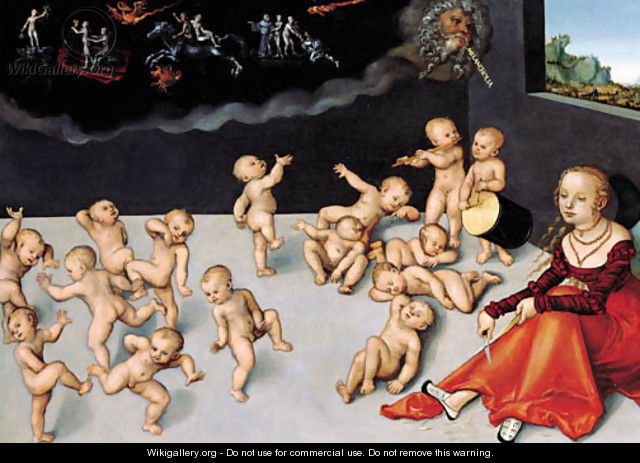
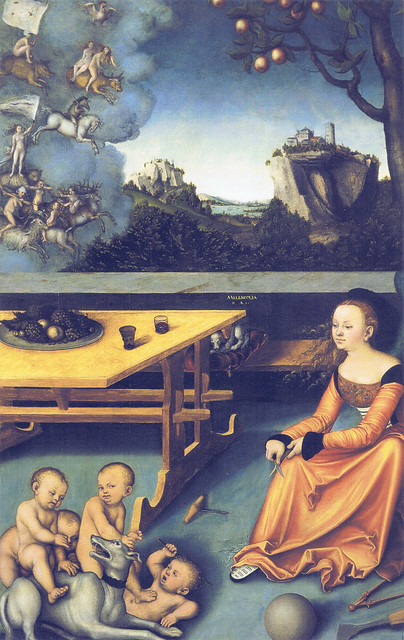
Apparently Lucas Cranach, the Elder created four versions of Melancholy - shown below from various sources.
Two images are the bottom are coming from the Flickr site, uploaded by pertrus.agricola.
He includes an amazing close-up of one of the paintings.

At a first glance I have no idea what the paintings are all about and what's it got to do with Melancholy. For my money, having so many naked babies around me playing with spheres and arrows, dogs and partridge running loose around the kitchen - I don't know anyone who wouldn't get melancholic in the face of that disaster.
I know, I am getting a little..... overwhelmed.

The works are obviously veiled and rather crypted.
I am yet to learn terribly a lot, armed with a copy of the Klibert, Panofsky, Saxl, book  Melancholy I.
This book became my little Christmas wish, I found it online and it is on its way...

At the moment, it seems that the eyes of the lady, especially in the versions from 1528 and 1532 may be those of Katherina von Bora, the wife of Martin Luther.
They new each other and Cranach was a close friend of the family, something I had read pointed to those eyes of the model.
There was something I had read about the this painting --->

Madonna under the fir tree (1510), Archdiocesan Museum, Wrocław. One of the most distinguished and elaborated of the Cranach's Madonnas.


Or maybe poor old Luc Cranach who knew Katherina from before she got married to Luther (I think so) and once he saw her with her babies thought holly crap, poor Kate...
something like this. I don't know. Maybe she was getting, like --- depressed....

I cannot see the eyes in the first two pics - they are too blurry so the search continues....

Melancholia - Lucas The Elder Cranach


There is a really interesting post and related comment on newly found blog:
http://ferrebeekeeper.wordpress.com/2010/09/16/melancholy-by-lucas-cranach/
I just read a bit of this blog and it is absolutely fabulous read for those husky golden retrievers as I...

It is the source of this pic --->
Lucas Cranach, the Elder
Melancholy
(1532) Oil on panel. 51 x 97 cm.
Copenhaguen, Statens Museum for Kunst)


photo


Lucas Cranach the Elder
The Melancholy
[1528]
One of four version, that Cranach painted with that topic.
Private Collection, on loan to the National Gallery of Scotland, Edinburg
photo


Lucas Cranach the Elder 
The Melancholy, detail [1532]
One of four version, that Cranach painted with that topic.
Colmar Musée d'Unterlinden


photo 


A fortified castle "on the rocks"
Lucas Cranach the Elder 
The Melancholy, detail [1532]
Copenhagen National Art Museum (Statens Museum)
Related Posts Plugin for WordPress, Blogger...